Ramp Reading: How the Tide Table Should Run Your Launch Day
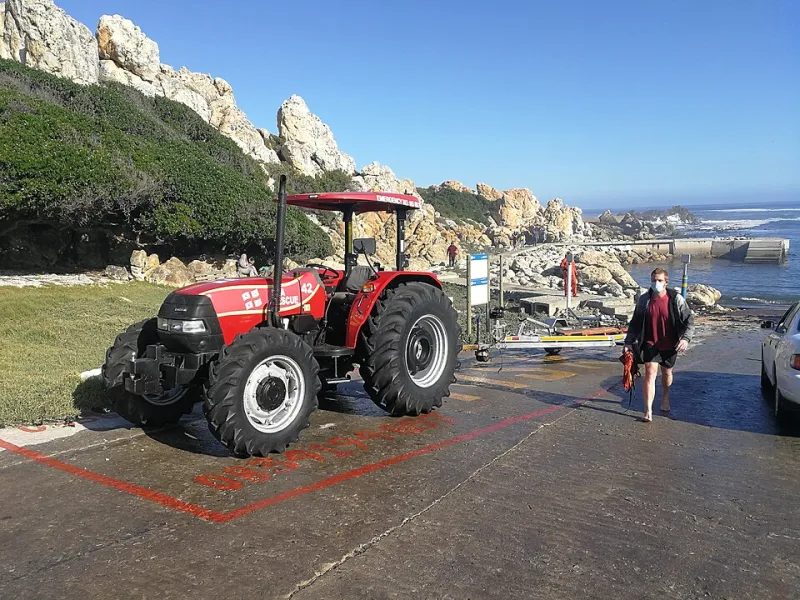
Photo: Pbsouthwood, CC BY-SA 4.0, via Wikimedia Commons
There is a particular expression on the face of a person standing at the top of a slipway at 4pm in August, holding a winch handle, watching the water retreat from their trailer. It is not panic. It's the slow realisation that the tide has been running a timetable all day and nobody consulted it.
Slipway work is not difficult. It is just unforgiving of improvisation. Here's the routine that keeps it dull in the best possible way.
Read the ramp before you read the tide
The tide table tells you when there's water. The ramp tells you whether it's usable. Those are different questions.
Before you leave home, look at the slipway on a map and, if you can, on a satellite view. A concrete apron into deep water behaves nothing like a shallow sand-and-seaweed affair at the end of a harbour wall. The gradient decides your window as much as the tide does: a steep ramp gives you a short usable band either side of high water, a shallow one gives you a long, muddy, wheel-spinning band that you'll regret.
Two things worth knowing before you commit: how far the ramp runs before it drops off the end, and where the weed and green algae sit. Cold, wet, algae-covered concrete has almost no grip, and a two-wheel-drive car with a light trailer will find that out in front of an audience.
The window is narrower than the tide table suggests
High water at Salcombe or Brixham at 11:40 does not mean you should arrive at 11:40. It means you want to launch on a rising tide with enough depth at the bottom of the ramp for the boat to float off — and you want to be recovered before the ebb leaves you dragging a keel up concrete.
A rough working rule: launch in the two hours before high water, recover in the two hours either side of it, and treat anything beyond that as a judgement call made by looking, not by hoping.
At Padstow and other harbour gates the calculation is stricter still, because the gate itself closes. There, the tide isn't a suggestion, it's an appointment.
Wind is the second tide
A 15-knot onshore breeze at a south-coast slipway turns a straightforward recovery into a wrestling match, and it cuts your usable window at the shallow end because the water gets pushed and chopped. Offshore wind makes the ramp calmer but makes the boat harder to hold alongside the wall while you fetch the car.
Check the direction relative to the ramp. If it's straight on the nose and gusting, either go earlier, go elsewhere, or accept that you'll want two people and a long line.
Recovery before dark is not a slogan
It's the single rule that prevents the worst days. Recovery in failing light means you're judging depth, gradient and trailer position by torchlight, with a tired crew and a wet winch strap.
Work backwards. If sunset is 19:20, you want the boat on the trailer by 17:30 and the car hitched by 18:00. That gives you a buffer for the engine that won't start, the trailer light board that's decided to sulk, or the queue at the wash-down point.
The August queue is real
Popular public slipways in high season — the sort at Mylor, Weymouth, Conwy, Whitby — develop a rhythm. The busy band is roughly 10am to 3pm, and it is polite to be quick. The unwritten etiquette: rig in the preparation area, not on the ramp; launch, move off, then sort yourself out afloat; recover promptly and clear the apron before you start strapping down.
If you're slow on the ramp, everything behind you is slow. The way to be fast is to have done the faffing earlier, in the car park.
Bylaws, tickets and the harbourmaster's good opinion
Slipway charges vary wildly — some are free, some are a few pounds in an honesty box, some are a tenner via an app, and some come with a permit you need in advance. Check before you travel. Also check for local restrictions: some councils ban jet ski launching at particular sites, some harbours require proof of insurance, and several inland waters have speed limits and registration requirements entirely separate from the coast.
If a harbourmaster or volunteer asks what you're doing, the answer 'launching for the day, back by four' goes a long way.
A calm day, in order
- The night before: check the tide, the wind, the slipway fee and the sunset time. Charge the trailer lights. Confirm the boat's battery is actually charged.
- On arrival: park clear of the ramp, rig the mast if you're sailing, load the kit, check the bung. Do the slow stuff away from the water.
- Launch: engine trimmed up, bow line on, one person driving, one steadying. Don't unhitch the winch strap until the boat is floating and the engine is running.
- Afloat: move away from the apron, then tidy. Sort fenders, rig lines, check you have the keys.
- Recovery: come in slowly and slightly angled to the wind, aim to place the bow rather than power onto the trailer. Winch, don't drive.
- Out: pull clear, strap down, rinse the brakes and the trailer, and let the hubs cool before a long tow.
Have an abort line
Decide before you go what would make you turn around: wind over a certain strength, a ramp that looks worse than expected, a queue that means you'd be recovering after dark. Saying it out loud in the car park is much easier than saying it with the boat half off the trailer and an audience forming.
The slipway doesn't care how keen you are. It only cares what the tide is doing. Work with it and the day stays pleasantly unremarkable — which is exactly what you want from a launch day.