Distance Kills the Day Sail: Choosing a Boat's Home Berth by Travel Time, Not Tariff

There is a particular kind of optimism that strikes on a Friday evening in a marina car park. The boat is tidy, the forecast is decent, and the drive was only — what, two hours? Two hours and ten with the roadworks. You will be back on Sunday night, tired but happy. Except the forecast shifts, the kids have a birthday party, and the two-hour drive starts to look less like a gateway to the water and more like a reason to mow the lawn instead.
The distance between your front door and your boat is one of the most expensive things you will never see on a invoice. It does not appear in the survey, the insurance quote or the mooring contract. But it determines how often the boat leaves the pontoon, and how often it leaves the pontoon is the single biggest factor in whether ownership feels like a hobby or a guilt trip.
The honeymoon drive
Every new owner does the drive happily for the first season. The car is packed with enthusiasm and a cool box. You leave at 6am, you are on the water by 9, and the world feels correctly ordered. By the second autumn, the same journey involves a flask, a podcast you are only half listening to, and a quiet calculation about whether the tide is worth it.
This is not laziness. It is arithmetic. A day sail from a berth ninety minutes away is not a day sail. It is a five-hour round trip wrapped around three hours of sailing, plus rigging, packing, parking and the bit where you stand in the shower block wondering why the water is always lukewarm. The sailing is the point, but the travel is the tax.
What the ninety-minute rule actually measures
Call it the ninety-minute rule if you like. The principle is simple: the practical radius for a boat you intend to use casually — a few hours, a picnic anchorage, a quick overnight — is roughly the distance you can cover in an hour and a half without resentment. Beyond that, the trip becomes an event. Events need planning. Planning kills spontaneity. And spontaneity is what separates a boat you own from a boat you visit.
It is not a hard border. A two-hour drive to a wonderful cruising ground can work beautifully if you go for full weekends and take the odd Friday off. But be honest about which owner you are. A boat kept two hours away is not a boat for a Wednesday evening. It is a boat for planned Saturdays. If your life already has plenty of planned Saturdays, fine. If it does not, the boat will sit.
Coastal marina, inland yard, or the driveway
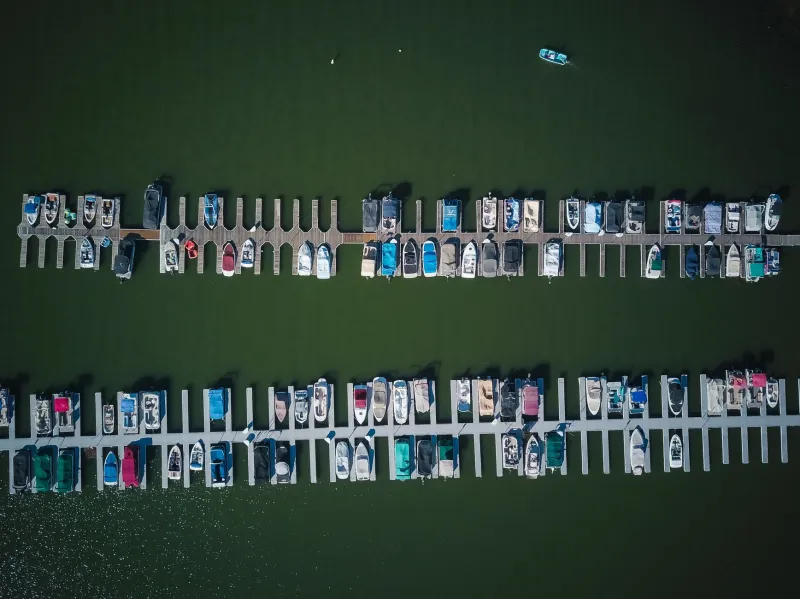
A coastal marina is the obvious choice, and often the right one. You get walk-on access, shore power, a pontoon to step onto and a town within walking distance. The trade-off is cost and demand. Popular south-coast berths can run to several thousand pounds a year, and waiting lists in the busiest spots are measured in seasons rather than weeks. You are paying for proximity and convenience, and that is not a con — it is the product.
An inland storage yard is the middle path. Dry sailing, trailer storage or a mooring on a lake or river can cost a fraction of a marina berth, but it introduces rigging time. A boat on a trailer at a yard forty minutes away can still be a day sail if you are disciplined. If the yard is two hours away and the rig takes an hour, you have built a part-time job.
Then there is the driveway. It is the cheapest berth in Britain and the most demanding. A trailer sailer in the garden means no mooring fee, no marina contract and no winter storage bill. It also means you are the crane, the trailer light board is your responsibility, and every launch involves a slipway queue. For some owners this is a point of pride. For others it is the reason the boat gets used twice a year and then listed in spring.
Doing the maths properly
Here is the comparison most buyers never run. Take the annual cost of the closer berth and subtract the annual cost of the cheaper one. Then subtract the extra fuel, the extra wear on the car, the extra meals out because you arrived late, and the occasional overnight stay you would not have needed otherwise. What is left is the real saving. Now divide it by the number of extra sails you would realistically do from the closer berth.
If the closer berth costs £1,800 more but you would use the boat ten more times a year, you are paying £180 a sail for convenience. That may be excellent value. If the cheaper berth saves £900 but you use the boat four times instead of twelve, the cost per sail has quietly doubled while the fun has quartered. The cheaper berth is not cheaper. It is a different product.
There is also a depreciation argument that rarely gets mentioned. Boats that are used regularly are looked after. Boats that are stored far away and visited rarely develop the small faults that turn into large bills: damp below, seized seacocks, flat batteries, a cover that has been flogging itself to death for six months. Distance does not just cost fuel. It costs attention.
A simple framework
First, write down the realistic door-to-water time, not the brochure time. Include the traffic you will actually meet on a Saturday morning in July, the bridge lift, the level crossing and the walk from the car park.
Second, decide how you want to use the boat. If the answer is ‘a few hours after work in summer’, then even forty-five minutes is too far unless the boat is on a mooring you can reach on foot. If the answer is ‘full weekends, once a month’, two hours is workable.
Third, price the whole commute, not just the berth. Fuel, parking, tolls, the Dartford Crossing if it applies, the Severn Bridge, the extra coffee. Multiply by the number of trips you honestly expect.
Fourth, check the season. A berth that is glorious in June can be a bleak drive in February. If the boat will be winterised anyway, the off-season distance matters less than you think.
Finally, visit at the time you will actually travel. A marina that feels charming on a Tuesday afternoon can be a different place on a sunny Sunday evening when the queue for the lock is an hour long and the car park is full.
The best berth is rarely the cheapest or the closest. It is the one that makes the boat easy enough to use that you stop thinking of it as a journey and start thinking of it as a habit. For most UK owners, that means something within ninety minutes, or a very good reason why not.