Before the Quote: How UK Insurers Judge a Boat You Haven’t Bought Yet

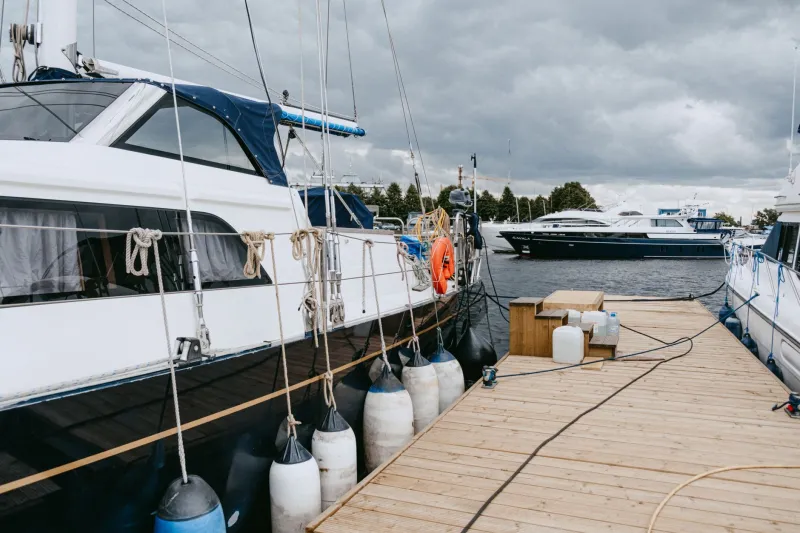
Photo: older GRP cruiser yacht marina UK insurance survey, via as2.ftcdn.net
Buying a boat often starts with the hull and ends with the paperwork. Insurance sits in the middle, and it has a habit of changing the mood. A boat that looks like a sensible buy on a brokerage listing can turn into a awkward conversation once an underwriter starts asking about moisture readings, mooring arrangements and whether the engine has ever had a proper service.
The quote is not a formality. For UK boat buyers, especially those looking at older GRP cruisers, it is a second opinion on the risk you are about to take on. And it is worth getting that opinion before you fall for the hull.
The quote starts before the survey
Insurers do not usually see the boat. They see a set of answers: make, model, year, hull material, length, engine type and age, mooring type, winter storage, security, your experience, your claims history. From that, they build a picture of risk.
For an older GRP cruiser, age alone is rarely the deciding factor. A well-kept 1980s boat can be perfectly insurable. What matters is evidence. Has the hull been surveyed recently? Are there moisture readings that suggest long-term water ingress? Has osmosis been treated, or merely mentioned in an old advert? Are there repairs to the keel, hull joint, deck core or transom? Have windows, hatches and deck fittings been resealed, or are they quietly leaking into the cabin?
Those questions are not the insurer being difficult. They are the same questions a sensible buyer should be asking. The difference is that the insurer can simply decline, restrict cover or add conditions.
Age is not the issue — evidence is
Engine age is a common sticking point. A diesel with high hours but a fat folder of service invoices is often easier to insure than a low-hours engine with no history. Underwriters may ask about cooling systems, exhaust elbows, mounts, fuel lines and spares availability. Older outboards and ageing marinised petrol engines can attract more scrutiny, particularly where parts are scarce or the installation looks home-brewed.
This is where a bargain can start to unravel. A boat priced low because it needs a engine rebuild is not necessarily a cheap boat. It is a boat with a known liability, and the insurer may want that liability dealt with before cover begins.
Where she lives matters as much as what she is
A marina berth with locked gates, CCTV and a resident berth holder is a different risk from a swinging mooring on an exposed estuary or a drying mooring with road access. Winter storage matters too. So does security: outboard locks, cabin alarms, hatch bars, dinghy storage and whether the yard is occupied all year.
Insurers may ask for a mooring agreement, not just a postcode. They may want to know whether the boat is lived aboard, used commercially, raced, or kept afloat through the winter. Those details can change the policy, the excess or the exclusions. If you are planning to keep an older cruiser on a cheap mooring to save money, check the insurance maths first. The saving on the water can disappear in the premium.
The survey is a risk report, not a second opinion
A pre-purchase survey is useful for you. An insurance survey is useful for the underwriter. They are not always the same thing, and some insurers will ask for a survey within a certain period or before cover is extended to a new boat.
Survey findings can become conditions. A surveyor might note that a seacock is stiff, a skin fitting is corroded, or a keel bolt needs attention. The insurer may require those items to be fixed within a set period, exclude them from cover, or apply a higher excess. In some cases, a serious finding can make the boat uninsurable on standard terms.
Ask the broker or owner for any recent survey and share it with your insurer for an indicative view. Do not assume a survey you have not read is a clean bill of health.
Agreed value versus market value
This is where older boats often cause confusion. An agreed value policy sets a fixed sum insured, usually based on a valuation, survey and receipts. If the boat is a total loss, the payout is the agreed figure, subject to the policy terms. It can be useful for boats with sentimental value or unusual spec, but it usually costs more and requires evidence.
A market value policy pays the lesser of the market value at the time of loss or the sum insured. For an older GRP cruiser, market value can be brutally lower than the asking price. A £25,000 listing is not an insured value. If the boat is written off in three years, the payout may reflect what a similar boat actually sells for then, not what you paid.
Ask which basis the quote uses. Ask what evidence is needed for agreed value. And ask what happens if the market moves.
Exclusions that catch people out
Cheap policies earn their margin in the exclusions. Wear and tear, osmosis, electrolysis, corrosion, gradual deterioration and faulty maintenance are common. Theft cover may require forcible entry, which matters if a outboard is lifted from a unlocked cockpit locker. Tenders, outboards and personal effects often have low sub-limits or separate terms. Racing, commercial use, liveaboard use and single-handed sailing may be excluded or require disclosure.
None of this makes a policy bad. It makes it a contract. Read the exclusions before you compare premiums, not after a claim.
Questions to ask before you make an offer
Ask the broker whether the boat has been continuously insured and whether there have been any claims. Ask for the engine service history, mooring details and any recent survey. Ask whether any insurer has declined, cancelled or imposed conditions on the boat. Then get an indicative quote using the real details, not a guess.
Before you commit, ask the insurer: what survey do you need, what will you exclude, what excess applies, and is the quote agreed value or market value? If the answer is vague, get another quote. A boat is only affordable if you can insure it, moor it, maintain it and use it. The insurer’s eye is not the enemy of a good buy. It is a useful check on whether the bargain is real.